

How To Make Paper Smell Like Money
Somehow, unexpectedly, I achieved the 100-dollar challenge in class! Incredibly, in a great show of his character, Andrew stayed true to his bet and stuck to his word, happily delivering the $100 despite any potential minor discrepancies in my case (Thanks again, professor, you're a great guy). Then he proceeded to dismiss class early.
Merrily, as I transferred the dollars from my pocket to my wallet, it hit me: money has a distinct smell. I'd try to describe it here, but it's nearly impossible. It smells like nothing else. It's similar to nothing else. It's got its own, unique smell. And after asking a few of my friends, they agreed. It also came to our attention that it's not just dollar bills that possess their own unique smell, but coins as well. So, naturally, the next question unanimously raised was "Why do both dollar bills and coins smell?"
Because it's noticed most often, and perhaps most apparent to all, it's probably best to begin examining the smell behind dollar bills. What about the "paper" money causes it to exhibit such an odor (or aroma, depending on the preference)?

One would naturally assume that it's what's within the dollar that causes it to exhibit the smell. After all, it only seems logical that the contents of the bill are what make it produce the odor/aroma that it does. This "paper" money, to the surprise of many…isn't actually made of paper. Instead, it consists of a combination of both linen and cotton. Obviously, in addition to that, there's the ink and other chemicals to infuse it with that green color. But we all know cotton and linen don't have such a powerful smell…so it must be the ink. However, this ink smells nothing like the ink we know of; so what is it in the ink, or the chemicals, that exhibits this odor?
It's reported that most of this odor can be contributed to chemicals such as aldehydes, furans, and other organic acids. There are a numerous array of others…. But these are classified to prevent counterfeit dollars and for other national security risks. So the public may never know precisely what combination of chemicals make American dollar bills smell the way they do.

In addition, as we've all probably noticed, new money doesn't smell the same as old money. Then what's the explanation for this? Is it still those chemicals?
The answer is no. The cotton/linen combination that makes up U.S. dollar bills has come to be known to be monumentally absorbent. Their fibers contract many of the materials that the dollar may come in contact with…unfortunately, this isn't always a good thing. These fibers, according to the Argonne National Laboratories in Chicago, may contain particles of cocaine…fecal matter…bacteria…sweat…and more. So the smell of those glorious dollar bills may not be so glorious after all.
As for why coins smell, the matter is monumentally more complex. The smell doesn't actually resonate from the coins, but rather from ourselves and our own body odor. Scientists state that this smell is "created by the breakdown of oils in skin after touching objects that contain the element" such as iron. So again, it's actually not the coin's metal itself that produces the odor. This was determined through a relatively complex experiment.
In a randomized control trial, individuals (the study failed to state how many) were given coins to handle with their bare hands. Afterwards, seven "subjects" stated that they noticed an odor after touching the coins. Researchers promptly took gas samples from the fingers of these seven individuals. Here, a moderately surprising realization was discovered: The smell was emanating from 1-octen-2-one, a molecule that forms when oils in the skin decompose. So now scientists were left with the question, "What part of the coins made this oil decompose?"
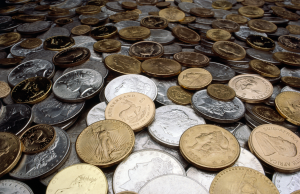
Although it's not set in stone, scientists believe that when fingers come into contact with the iron in coins, perspiration causes these iron atoms to gain two electrons. Livescience states that, "The doubly negative iron atoms react with oil in skin, causing them to decompose, forming 1-octen-2-one." The scientists believe that this happens because our very own blood contains iron. And when blood is rubbed over skin, a metallic smell is also produced, which is resoundingly similar to coins (and vice versa).

In a short critique of the study, I don't believe the size matters too much. The interaction between iron and perspiration would likely be consistent whether it be between two individuals, or one thousand. However, the confounding variable issue presents itself as it does so often. The reasonable, sensible mechanism discovered proves that this was not a resounding problem though. The study wasn't anything absolutely perfected to every last detail- but I don't believe it needed to be.
So in the end, as stated before…the smell of money may not be as glorious as it's made out to be. Many will state "money is the smell of success".
But scientists have discovered it's a little less than successful… and more of our own body odor, cocaine, fecal matter, and chemicals.
As a broke college student though, I'll gladly cherish that smell of $100.
Thanks again Andrew- it means a lot.
How To Make Paper Smell Like Money
Source: https://sites.psu.edu/siowfa15/2015/12/01/the-smell-of-money-slightly-less-than-success/
Posted by: johnsonfately.blogspot.com
0 Response to "How To Make Paper Smell Like Money"
Post a Comment